Sunday, May 15, 2011

Snow Crash by Neal Stephenson (4 stars)


The United States of America is reduced to a suburb-state within its previous geographic boundaries; millions live in palaces in a virtual reality Metaverse while their bodies sit in 'houses' in former storage garages subdivided into a concrete ghetto; the mafia delivers pizzas, and being a pizza delivery driver (a 'Deliverator') is a high-risk superstar occupation like being a formula-1 driver of decades past:

When the Deliverator puts the hammer down, shit happens. You want to talk contact patches? Your car's tires have tiny contact patches, talk to the asphalt in four places the size of your tongue. The Deliverator's car has big sticky tires with contact patches the size of a fat lady's thighs. The Deliverator is in touch with the road, starts like a bad day, stops on a peseta.

Stephenson creates a fantastic cyberpunk world, with a good eye for forward-looking technology advancements, given it was penned in 1992. He has a wry sense of humour and witty writing style that pervades all parts of the book, including our hero protaganist 'Hiro Protagonist' and offsider 15-year-old Your's Truly or 'Y.T.':

"Y.T. Where are you?"
"In the parking lot of a Safeway on Oahu," he says. And he's telling the truth; in the background she can hear the shopping carts performing their clashy, anal copulations.

Everything is a franchise: countries, crime, the mafia, religion. Compton is still a dangerous place, run by managers following instructions from a three-ring binder that tells them how to run their Narcolombia franchise. I loved the description of Fed-land where penny-pinching is taken to the extreme such that employees need to establish toilet-paper communal funds to stock bathrooms.

Snow crash is wreaking havoc on the Metaverse, and the real world at the same time. Cue the incredibly boring, ridiculous explanation of verbal viruses based on Sumerian ancient texts and other religious historical research in worse-than-Dan-Brown format.

"Deuteronomy is the only book of the Pentateuch that refers to a written Torah as comprising the divine will: 'And when he sits on the throne of his kingdom, he shall write for himself in a book a copy of this law, from that which is in charge of the Levitical priests; and it shall be with him, and he shall read in it all the days of his life, that he may learn to fear the LORD his God, by keeping...

yawn. It is a tragedy that Stephenson wrote these passages where Hiro has lengthy discussions with the Librarian. They destroy the flow of the book, and seem to only exist because Stephenson spent a lot of time doing this research and wanted to include it in the final product. The book would have been far better with no explanation, or a limited summary such as Hiro gives to Mr. Lee and Uncle Enzo. It cost you a star Mr. Stephenson, I'm sure you're crushed.

4 stars.

Sunday, May 8, 2011

The Lies of Locke Lamora by Scott Lynch (4.5 stars)

The Lies of Locke Lamora has been on my to-read list for a long time. I tried to find it in book stores a few times, and it was never in stock, so I was very pleased to see there was a kindle edition.

It is different from most fantasy novels in a couple of ways: there is a lot of swearing that seems strangely modern, i.e. suited for the times of guns and cars, rather than swords and horses where the novel is set.  In a way that also fits with the other difference, the presence of 'elderglass' skyscrapers left behind by the planet's previous alien inhabitants and occupied by the current generation of  less technologically advanced humans.

The dialogue is often very witty, and Locke is written in a hilarious sarcastic and irreverent style.  This passage where he completely ignores Chains' advice about how to treat a Bondsmage (sorcerer) with respect is a great example:

"Sorcery's impressive enough, but it's their fucking attitude that makes them such a pain.  And that's why, when you find yourself face to face with one, you bow and scrape and mind your 'sirs' and 'madams.'" 
"NICE BIRD, asshole," said Locke.
The Bondsmage stared coldly at him, nonplussed.

Lynch also seems to have a particular interest in food - he treats us to detailed explanations of food that Locke and the other Gentleman Bastards prepare, and makes the culinary arts a particularly unlikely part of their con-artist education. His description of the Duke's banquet "The bullock's head with the body of a squid, he was happy to avoid" was like something straight out of Heston's feasts.

I thought Lynch could have spent longer with Locke in the dank underground caverns with the Thiefmaker, that community and life was fascinating and very Dickensian. And while I enjoyed the racing plot line of the climax, the switch to James Bond-esque thriller and Locke's sudden growth of a social conscious didn't fit well with the rest of the novel.

Despite these minor flaws, I loved it and will be reading the sequel Red Seas Under Red Skies.

4.5 stars.

Saturday, April 16, 2011

Rocket Boys by Homer Hickam Jr. (3.5 stars)


This autobiographical book was the inspiration for the movie October Sky (an anagram of Rocket Boys): a story of a kid growing up in a West Virginian mining town who beats the odds to pursue his dream of becoming a rocket engineer. The pictures of life in Coalwood were well-drawn, but I felt disconnected from most of the characters. This surprised me since it is written as a novel, rather than a completely historical account. I found myself liking Quentin a whole lot more than Sonny - not only did he have pretty much all the brains, he often provided the drive and motivation.

I enjoyed reading this book, but I can't think of much to praise or criticise, and it isn't a story that will stick with me for a long time. One reviewer mentioned this book is one of those rare breeds where the movie is better than the book. I'll have to check out the movie and see if I agree.

3.5 stars.

Sunday, April 10, 2011

The Wise Man's Fear by Patrick Rothfuss (5 stars)

This is the second in the Kingkiller Chronicles, sequel to The Name of The Wind, which was one of the best books I read last year.  I was keen to read this and see how Rothfuss would follow his impressive debut.

The book continues to lay out the life of Kvothe, our ridiculously over-talented protagonist, through his adventures at the university and thankfully, in this book, breaking the Harry Potter mold to venture out into the real world for some adventure.  Kvothe certainly adds to his real-world experience: gaining favour in a royal court, leading a band of mercenaries, and training with the Adem super-ninjas. 

The sections of the book where he lives with Felurian and the Adem felt a bit like obligatory "skilling up" in a computer game.  Those sections seemed to be about "+10 experience with women" and "+10 combat skills", getting Kvothe ready for book three.  At least they were entertaining training montages.

In the first book I loved Elodin, but I think his character sucked in this one.  His "classes" were supposed to be ridiculous, but I found some of the comments and humour better suited to college jocks than to Elodin's eccentric and mysterious academic character:
Uresh.  Your next assignment is to have sex.  If you do not know how to do this, see me after class.
At times Rothfuss used some bizarre time compression, like his description of the entire boat trip from the university:
In brief, there was a storm, piracy, treachery, and shipwreck, although not in that order.  It also goes without saying that I did a great many things, some heroic, some ill-advised, some clever and audacious.
Sounds to me like his editor told him to take out an unnecessary plot line, but he didn't want to completely remove it.  And this was only one of a number of times that Kvothe loses absolutely all of his possessions except his extremely expensive lute which somehow miraculously survives each time.

Another character incongruity that bothered me was after Kvothe left the Adem he seemed to throw out all the psychological lessons they taught him and turn into a bloodthirsty arsehole.  Within a few pages he was killing a whole heap of people and saying things like:
And if you ever do anything to either of them, I'll know.  I will come here, and kill you, and leave your body hanging in a tree.
Oh, and I haven't read such ridiculous sexual tension as when Kvothe and Denna are bathing in the stream near Imre since the Twilight series.

Having said all that, I really did like this book, and it was pretty much impossible to put down.  The world Rothfuss has created is fascinating.  The branches of magic: sympathy, sygaldry, naming etc. are well presented, and semi-scientific.  I love the Chandrian, so dark, myseterious, and powerful that even speaking their true names can be a death sentence. 

Now for some spoliers and plot guessing.  I suspect that Bredon is an Amyr - he is too involved in the story to not show up again.  He may also turn out to be Mister Ash - Denna's patron, or her patron could be one of the Chandrian.  I think there are also more surprises coming about Bast, and I'm sure Kvothe's little Adem training friend will save his life at least once.

Update: I originally gave this 4.5, but decided I was being too harsh. 5 stars!

Tuesday, March 22, 2011

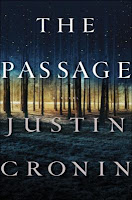
The Passage by Justin Cronin (4 stars)

The Stand meets I Am Legend meets The Road, what's not to like?

Cronin's venture into apocalyptic vampire fiction is unusual in that he covers both pre and post apocalypse in significant detail.  I think a lot of authors would have just started immediately after the viral outbreak, or even later after the survivors have been living behind the walls of The Colony for a number of generations.

The result is a huge break in the story almost exactly one third of the way through the book when the virus is released.  Many of the central characters die and are replaced by completely unknown, but even more important, characters.  This break in the story is quite unsettling, but on reflection I think it is something I like about the novel.

I was less impressed with the switches between Sara's journal epistolary style and the regular third person - it just seemed like a lazy way to fill in travel time, and much of it was boring: got food here, water there.  There were also some ridiculous coincidences sprinkled throughout the book, like when they find an orchard in Utah(!!) just after they had run out of food, followed by an Outdoor World when they really needed equipment and weapons.  Just as an aside Outdoor World would be my first stop for post-apocalyptic shopping :)

I'm a sucker for post-apocalyptic survival stories, so I liked descriptions of The Colony's daily life: watches, battle training, power maintenance, lights.  Hiding the horrors of the real world from the kids until they were 8 seems like a strategy that, while well meaning, could result in some serious psychological damage as their safe world crumbles.  What is worse?  Knowing or not knowing?

There are many parallels to The Stand: Auntie is very close to Mother Abagail, Vegas for the bad guys and Colorado for the good guys, and the apocalypse is caused by a virus that escapes from a military facility.  Having said that, The Passage is much less mystical/religious than The Stand.  The vampires/virals/smokes seemed to be directly lifted from I Am Legend.

Many people on amazon have described the book as horror, but it didn't read like horror to me.  However, it could be made into a fantastic and really scary movie.

I'm not sure how this will go as a trilogy - I thought Cronin tidied up more loose ends than were necessary, making for a ragged ending that dragged on for quite a while after the climax.  There are plenty more original virals to hunt down, so he has left himself plenty of story.

4 stars.

Sunday, March 6, 2011

Blood Meridian: Or the Evening Redness in the West by Cormac McCarthy (2.5 stars)

I was ready to love this book. The Road and No Country for Old Men are both fantastic books, and many reviewers on Amazon claim this is McCarthy's best work. I don't agree.

Like most McCarthy books, it is often difficult to tell who is speaking and what is going on, but I was ready for that. What I wasn't ready for was the rambling dense prose, often waxing philosophical, so different from the punchy and intense dialogue of The Road and No Country:

Whether his history should run concomitant with men and nations, whether it should cease. He'd long forsworn all weighing of consequence and allowing as he did that men's destinies are given yet he usurped to contain within him all that he would ever be in the world and all that the world would be to him and be his charter written in the urstone itself he claimed agency and said so and he'd drive the remorseless sun on to its final endarkenment as if he'd ordered it all ages since, before there were paths anywhere, before there were men or suns to go upon them.

BUH??  I feel like one day McCarthy is going to say "Surprise! I wrote that with a computer program that looks up random words in a thesaurus!". A reviewer on Amazon summed it up perfectly with:

It's the kind of book everybody wants to have read, but few enjoy reading. As such, it naturally elicits a certain kind of intellectual pretension in those who have slogged through it.

Unlike other McCarthy books I can't even say the characters were great. The judge is a horrible character that commits seemingly random acts of violence, a sort of wild west version of Mark 'Chopper' Read. But we never really know him deeply, or indeed at all, and instead are left to wonder at the horror of his actions. The Kid, notionally the central character, is also bereft of any deep development.

The story McCarthy tells is of a band of American misfits on the wild west frontier. They become killers tasked with collecting scalps of Apaches and other Indians, before turning their hand to collecting scalps of pretty much anyone: Mexicans, settlers, and their own. All of this happens in a dream-like landscape alternating between gore, complex descriptions of the desert, and philosophy.

2.5 stars.

Friday, February 18, 2011

The Silmarillion by JRR Tolkien, edited by Christopher Tolkien (0 stars)

The SilmarillionThe Silmarillion is now officially the worst book I have ever read, easily beating out The Savage Detectives.  I have to admit to not really knowing what I was getting myself into with this book - it feels very similar to reading the bible.  Thousands of years are covered in its pages: epic battles are described with single sentences, and hundreds of characters and places are introduced and immediately discarded.  It's not quite 'Abraham begat Isaac; and Isaac begat Jacob; and Jacob begat...', but it isn't far off either:

The Feanturi, masters of spirits, are brethren, and they are called most often Mandos and Lorien. Yet these are rightly the names of the places of their dwelling, and their true names are Namo and Irmo.

Namo the elder dwells in Mandos, which is westward in Valinor. He is the keeper of the Houses of the Dead, and the summoner of the spirits of the slain. He forgets nothing; and he knows all things that shall be, save only those that lie still in the freedom of Iluvatar. He is the Doomsman of the Valar; but he pronounces his dooms and his judgements only at the bidding of Manwe. Vaire the Weaver is his spouse...

If you think this is just background, and the real story is coming, think again. I can see that Tolkien wanted to create a mythology and a world for his language to live in outside of the timelines of LOTR and The Hobbit, but did it have to be in such a boring format? Even if he had gone into some detail about the battles, or life in the elvish cities it might have held my interest. I'm bailing at page 248.

0 stars.