Saturday, August 1, 2009

Eclipse by Stephenie Meyer (3.5 stars)


Book number 3 in the Twilight series, I give this one some credit, and I certainly enjoyed it more than the previous two. However, there are still lots of spew-worthy moments:
It was a face any male model in the world would trade his soul for. Of course, that might be exactly the asking price: one soul.

The plot direction is super obvious - someone is creating new vampires, oh really, who could that be? And Edward's ridiculous over-confidence makes it obvious the real battle is going to be wherever they think Bella is 'safe'.

The literary comparisons are overdone again (this time it is Wuthering Heights), but not as terribly as in New Moon. I'm also pretty sick of the whole love triangle thing - can't we have some more battles with the Volturi or something?

Meyer introduced the creepy 'imprinting' thing for the Werewolves. I wonder if this is going to be a convenient plot escape for Jacob in the next book? Is he also going to fall in love with a two-year old (like his pack-mate), and give up on Bella?

I just read some of the Twilight forums (wow, people, really), and checked out the merch store (Bella's bracelet anyone?). I'm surprised they have mens T-shirts, is there anything more emasculating than a Twilight T-shirt?

Those who haven't seen it should check out the XKCD comic (NSFW language).

3.5 stars.

Wednesday, July 29, 2009

In Defence of Food by Michael Pollan (4.5 stars)


I think this is the best food-related book I have ever read. The advice is distilled by the author into:
Eat food. Not too much. Mostly plants.

Pollan writes very well, and the book is the perfect length to be informative but not boring. He explains the rise of nutritionism - treating food as the sum of its currently known parts, the dangers of this approach, and how it has changed the western diet:
Milk through this lens is reduced to a suspension of protein, lactose, fats, and calcium in water, when it is entirely possible that the benefits, or for that matter the hazards, of drinking milk owe to entirely other factors (growth hormones?) or relationships between factors (fat-soluble vitamins and saturated fat?) that have been overlooked...The entire history of baby formula has been the history of one overlooked nutrient after another: Liebig missed the vitamins and amino acids, and his successors missed the omega-3s...

The 'Lipid Hypothesis' is one of the great failings of nutritional science, and has fundamentally changed the food landscape. Is there anything in the supermarket these days that isn't low fat? How bout this bombshell:
The amount of saturated fat in the diet may have little if any bearing on the risk of heart disease, and evidence that increasing polyunsaturated fats in the diet will reduce the risk is slim to nil.

I was fascinated by this book, and the advice rings true. To summarise:

  • Avoid foods that: include ingredients with unfamiliar/unpronounceable names, have more than five ingredients, or contain high fructose corn syrup. From our experience in the US it is extremely difficult to avoid the evil corn syrup in American supermarkets, it is in pretty much everything. Pollan uses the example of Sara Lee 'bread' as something to avoid - we called it 'cake bread'.
  • If your great-grandmother wouldn't recognise it as food, don't eat it.
  • Avoid food products that make health claims. The FDA in the US allows 'qualified' health claims on packaging, read 'lies'.
  • Eat mostly plants, especially leaves. Leaves are better than seeds because seeds are high energy storage mechanisms.
  • You are what you eat eats too. Chicken, pigs and cows all grow quicker when fed grains, but are healthier when eating grass. Roo is good for you because it is wild, and hence eats a diverse diet of plants. Wild plants have to defend themselves without pesticides, so have higher quantities of antioxidants and other goodies than farmed plants.
  • Eat like an omnivore. The more diverse your diet is, the better chance you have of covering all the nutritional bases.

There is plenty more advice, this is just some of it. I don't have the knowledge to critique it for scientific accuracy, but I don't think anyone will be harmed by following this advice.

I'm also going to read the "The Omnivore's Dilemma".

4.5 stars.

Saturday, July 25, 2009

The Known World by Edward P. Jones (3 stars)

The subject of this book is intriguing - it largely focuses on the story of slave-owning free blacks in Virginia in the 1850s. The idea of free blacks owning slaves had never even occurred to me before picking up this book. Jones explores the complicated relationships between whites, free blacks, slaves, politics and the law in a way that eroded the simplistic view I had of slavery in America at that time, and won him the Pulitzer.

The issues are complex, and I still find myself ill-equipped to answer the question 'Why would free blacks own slaves?'. Part of the answer is they were buying freedom for their families. A talented slave who was permitted to make money might eventually buy his/her freedom with money earned from making furniture, boots etc. and go on saving to buy freedom for his/her family. Once their family was secure, free blacks were looking to expand their wealth and secure their future by buying land and farming. Slavery dominated the labour market, and I imagine it was difficult to find labourers that could be paid a wage, so free blacks would buy slaves to work the land.

Jones painfully demonstrates that a free slave's hold on freedom is very tenuous - there was much money to be made in kidnapping free slaves and selling them back into slavery. With the only proof of freedom being 'free-papers' carried by the slave, these could easily be destroyed and there were plenty of unscrupulous buyers available.

Although the subject matter was interesting, the writing good, and Jones deals with the subject matter thoughtfully, I didn't enjoy this book very much. The writing constantly jumps around in time, from weeks to decades, often in the same paragraph and there are a huge number of characters, which are difficult to keep track of. The book finally seemed to be building to a climax in the final pages, but the narrative style kept me strangely disconnected from the events so I didn't have a burning desire to read on.

3 stars.

Thursday, July 16, 2009

The Brief Wondrous Life of Oscar Wao by Junot Diaz (3.5 stars)


I can see why this won a pulitzer. I loved the language, and the writing style (yes, there is lots of swearing):

I guess I should have fucking known. Dude used to say he was cursed, used to say this a lot, and if I'd really been old-school Dominican I would have (a) listened to the idiot, and then (b) run the other way. My family are surenos from Azua, and if we surenos from Azua know anything it's about fucking curses.

The passionate style at times reminded me a little of stand-up comedy in terms of delivery. I think this would make a fantastic audio book. The untranslated Spanish was occasionally annoying, but mostly I found those sentences interesting. The other languages in the book belong to sci-fi/fantasy geeks, and although I got most of the references, I missed plenty too (been too long since I read Dune):

Even a woman as potent as La Inca, who with the elvish ring of her will had forged within Bani her own personal Lothlorien, knew that she could not protect the girl against a direct assault from the Eye.

Oscar is a great character, similar in many ways to Ignatius J. Reilly, but I would have liked to know him better. I felt limited by the narrator's view of him.

The insight into the brutality of Trujillo in the Dominican Republic was fascinating, and although lots of information was delivered in footnotes, they weren't boring footnotes.

I felt a little off-balance by the perspective changes and plot jumps, and that wasn't helped by reading the book in smaller chunks than usual.

3.5 stars.

Sunday, July 5, 2009

Uglies by Scott Westerfeld (4.5 stars)

Some more Young Adult fiction, this one on recommendation from a friend. Brilliant book, and I totally want a hoverboard (to be honest I've wanted one since Back to the Future came out, but now more so).

The themes of healthy self/body-image, free society, and environmentalism are not exactly subtle, but given the target audience is young adult I'm prepared to cut it some slack. The escape from mainstream society and life in The Smoke had strong overtones of Tomorrow, When the War Began. I think the premise of making everyone 'pretty' to remove Darwinian evolutionary advantages of people with highly symmetrical faces and particular body shapes is brilliant (for a story that is, not government policy). As Tally explains it, before the operation existed:
People who were taller got better jobs, and people even voted for some politicians just because the weren't quite as ugly as everybody else...Yeah, and people killed one another over stuff like having different skin color.

Of course, the operation is not all as it seems. I will definitely be reading the sequels Pretties, and Specials.

4.5 stars

Tuesday, June 30, 2009

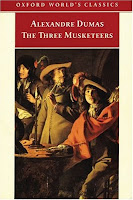
The Three Musketeers by Alexandre Dumas (4 stars)


Swashbuckling! This book's characters serve as a definition for the word!

I enjoyed reading about the adventures of M. d'Artagnan and his three friends. At the start of the book d'Artagnan can barely travel down the road without engaging strangers in duels over some perceived slight, and indeed this is how he first meets the musketeers. Together they perform all sorts of ridiculous feats: foiling the cardinal's machinations, defeating large numbers of enemy soldiers while breakfasting at the siege of La Rochelle, and avoiding assassination attempts by the evil Lady de Winter.

Highly entertaining, although I did wonder what readers would have thought of it when it was published in 1844? Would it have been the equivalent of an modern action novel, something like a Tom Clancy book?

I was also incredibly confused by the currency in the book: pistoles, livres, crowns, francs etc. This is common enough that it deserves its own Wikipedia page :)

4 stars.

Monday, June 15, 2009

Gilead by Marilynne Robinson (1 star)


Gilead won the Pulitzer prize in 2005, and although it didn't sound particularly appealing I thought I'd give it a shot. I initially liked the measured, reflective narrative style, but it quickly sent me to sleep. I struggled to concentrate on the largely boring, rambling, grandpa-simpson "there's an interesting story behind this silver dollar" kind of prose that trundles in random directions without any cohesion. I'm giving up 90 pages in, sorry Ms. Robinson.

1 star