Tuesday, March 22, 2011

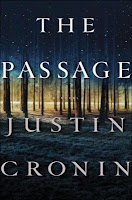
The Passage by Justin Cronin (4 stars)

The Stand meets I Am Legend meets The Road, what's not to like?

Cronin's venture into apocalyptic vampire fiction is unusual in that he covers both pre and post apocalypse in significant detail.  I think a lot of authors would have just started immediately after the viral outbreak, or even later after the survivors have been living behind the walls of The Colony for a number of generations.

The result is a huge break in the story almost exactly one third of the way through the book when the virus is released.  Many of the central characters die and are replaced by completely unknown, but even more important, characters.  This break in the story is quite unsettling, but on reflection I think it is something I like about the novel.

I was less impressed with the switches between Sara's journal epistolary style and the regular third person - it just seemed like a lazy way to fill in travel time, and much of it was boring: got food here, water there.  There were also some ridiculous coincidences sprinkled throughout the book, like when they find an orchard in Utah(!!) just after they had run out of food, followed by an Outdoor World when they really needed equipment and weapons.  Just as an aside Outdoor World would be my first stop for post-apocalyptic shopping :)

I'm a sucker for post-apocalyptic survival stories, so I liked descriptions of The Colony's daily life: watches, battle training, power maintenance, lights.  Hiding the horrors of the real world from the kids until they were 8 seems like a strategy that, while well meaning, could result in some serious psychological damage as their safe world crumbles.  What is worse?  Knowing or not knowing?

There are many parallels to The Stand: Auntie is very close to Mother Abagail, Vegas for the bad guys and Colorado for the good guys, and the apocalypse is caused by a virus that escapes from a military facility.  Having said that, The Passage is much less mystical/religious than The Stand.  The vampires/virals/smokes seemed to be directly lifted from I Am Legend.

Many people on amazon have described the book as horror, but it didn't read like horror to me.  However, it could be made into a fantastic and really scary movie.

I'm not sure how this will go as a trilogy - I thought Cronin tidied up more loose ends than were necessary, making for a ragged ending that dragged on for quite a while after the climax.  There are plenty more original virals to hunt down, so he has left himself plenty of story.

4 stars.

Sunday, March 6, 2011

Blood Meridian: Or the Evening Redness in the West by Cormac McCarthy (2.5 stars)

I was ready to love this book. The Road and No Country for Old Men are both fantastic books, and many reviewers on Amazon claim this is McCarthy's best work. I don't agree.

Like most McCarthy books, it is often difficult to tell who is speaking and what is going on, but I was ready for that. What I wasn't ready for was the rambling dense prose, often waxing philosophical, so different from the punchy and intense dialogue of The Road and No Country:

Whether his history should run concomitant with men and nations, whether it should cease. He'd long forsworn all weighing of consequence and allowing as he did that men's destinies are given yet he usurped to contain within him all that he would ever be in the world and all that the world would be to him and be his charter written in the urstone itself he claimed agency and said so and he'd drive the remorseless sun on to its final endarkenment as if he'd ordered it all ages since, before there were paths anywhere, before there were men or suns to go upon them.

BUH??  I feel like one day McCarthy is going to say "Surprise! I wrote that with a computer program that looks up random words in a thesaurus!". A reviewer on Amazon summed it up perfectly with:

It's the kind of book everybody wants to have read, but few enjoy reading. As such, it naturally elicits a certain kind of intellectual pretension in those who have slogged through it.

Unlike other McCarthy books I can't even say the characters were great. The judge is a horrible character that commits seemingly random acts of violence, a sort of wild west version of Mark 'Chopper' Read. But we never really know him deeply, or indeed at all, and instead are left to wonder at the horror of his actions. The Kid, notionally the central character, is also bereft of any deep development.

The story McCarthy tells is of a band of American misfits on the wild west frontier. They become killers tasked with collecting scalps of Apaches and other Indians, before turning their hand to collecting scalps of pretty much anyone: Mexicans, settlers, and their own. All of this happens in a dream-like landscape alternating between gore, complex descriptions of the desert, and philosophy.

2.5 stars.

Friday, February 18, 2011

The Silmarillion by JRR Tolkien, edited by Christopher Tolkien (0 stars)

The SilmarillionThe Silmarillion is now officially the worst book I have ever read, easily beating out The Savage Detectives.  I have to admit to not really knowing what I was getting myself into with this book - it feels very similar to reading the bible.  Thousands of years are covered in its pages: epic battles are described with single sentences, and hundreds of characters and places are introduced and immediately discarded.  It's not quite 'Abraham begat Isaac; and Isaac begat Jacob; and Jacob begat...', but it isn't far off either:

The Feanturi, masters of spirits, are brethren, and they are called most often Mandos and Lorien. Yet these are rightly the names of the places of their dwelling, and their true names are Namo and Irmo.

Namo the elder dwells in Mandos, which is westward in Valinor. He is the keeper of the Houses of the Dead, and the summoner of the spirits of the slain. He forgets nothing; and he knows all things that shall be, save only those that lie still in the freedom of Iluvatar. He is the Doomsman of the Valar; but he pronounces his dooms and his judgements only at the bidding of Manwe. Vaire the Weaver is his spouse...

If you think this is just background, and the real story is coming, think again. I can see that Tolkien wanted to create a mythology and a world for his language to live in outside of the timelines of LOTR and The Hobbit, but did it have to be in such a boring format? Even if he had gone into some detail about the battles, or life in the elvish cities it might have held my interest. I'm bailing at page 248.

0 stars.

Sunday, January 30, 2011

Starship Troopers by Robert A. Heinlein (3 stars)

Starship TroopersStarship Troopers is a classic of the Sci-Fi genre.  It won the Hugo in 1960, and was made into a movie in 1997 by a director who, rumour has it, didn't even finish reading the book.

Having seen the movie first, I was quite surprised to find this book was as much about the war with 'the bugs' as Animal Farm is about animals on a farm.  Heinlein uses the futuristic war as a minor plot device to present his philosophy on government, crime, and punishment.  He essentially blames the crime problems of the late 20th century on bleeding heart liberalism that avoided harsh punishments for minors.  In Heinlein's society all crime is sorted out quickly with a good flogging (literally).

Heinlein's crime-free society of the future is governed by veterans - only those who have served a term in the military are 'citizens' and have a right to vote.  Unlike most cases in history where a small class of people have reserved the right to vote and make decisions, the rights of those who can't vote have been perfectly preserved and the 'citizens' haven't sought any advantage for themselves.  Hmmm...

The implausibility doesn't stop there.  While I liked the sentiment of reducing the number of armchair officers in the army and deploying every single person into battle, I just don't think it would work as presented by Heinlein.  If your most senior generals and strategists who are running the war can 'buy a farm' all at once in a fight on the ground, as easily as a private, it is going to be pretty difficult to maintain cohesion and long term strategy.  Not to mention that the senior leadership holds the most valuable information and would be equally as prone to capture as the most junior grunt.

In any case, I found the book interesting, but probably would have liked it a lot more if it actually was a Sci-Fi novel, not a philosophy discussion with a Sci-Fi framework.

3 stars.

Monday, January 24, 2011

The Bonfire of the Vanities by Tom Wolfe (5 stars)

The Bonfire of the Vanities1980s GREED in New York! The main character in The Bonfire of the Vanities, Sherman McCoy, is a brilliant depiction of 1980s greed: he has a multimillion-dollar income as a bond salesman at Pierce and Pierce on Wall street, a huge apartment on Park Avenue featured in Architectural Digest, a complete inability to describe what he actually does for a living, and a stupendous ego and arrogance as a self-described 'Master of the Universe'.

Sherman comes to strife in the Bronx with his deliciously evil mistress, and the reader follows as his life unravels and he rides the rollercoaster down into the territory of the downtrodden Bronx legal system. This arc brings him into contact with great characters like sleazy criminal defense attorney Thomas Killian, and Larry Kramer who believes his best chance at getting chicks is to impress female jurors with a showy TV-style trial manner and strong sternocleidomastoid muscles.

As Sherman's star falls, Peter Fallow, the epitome of unethical tabloid journalism, rides his story to success with the help of the morally dubious Reverend Bacon. I loved the description of Fallow's life before his big story, and his attempt to bury the monster of his shame in alcohol (preferably paid for by someone else):

Something had happened last night. These days he often woke up like this, poisonously hung over, afraid to move an inch and filled with an abstract feeling of despair and shame. Whatever he had done was submerged like a monster at the bottom of a cold dark lake. His memory had drowned in the night, and he could feel only the icy despair. He had to look for the monster deductively, fathom by fathom.

Wolfe's writing is masterful. I enjoyed his depiction of Sherman's social failure, 'a social light of no wattage whatsoever', at the high-society Bavardages' dinner party amidst the 'hock-hock-hock' and 'haw-haw-haw' of fake laughter from the society automatons. The description of Sherman and his wife's transport to the party captures the ridiculous lifestyle of New York's extremely rich. Having discounted taking a cab as too low-brow, and not even considered walking, the McCoys (remember this is 1980s dollars):

...had hired this car and this driver...who would drive them six blocks, wait three and a half or four hours, then drive them six blocks and depart. Including 15 percent tip and the sales tax, the cost would be $197.20 or $246.50...

I loved this book. I was going to complain about the abrupt ending, but somehow it seemed fitting to have Sherman 'dressed for jail' and completely embracing the loss of everything in the midst of the mob.

5 stars.

Saturday, January 8, 2011

Seabiscuit: an American Legend by Laura Hillenbrand (5 stars)

Seabiscuit: An American LegendI came to this true story with a fair degree of skepticism, since I have a complete disinterest in horses and horse racing. So how did I come across this book? Hillenbrand's Seabiscuit is at number 11 on Amazon when you rank all books by average customer review. This is pretty amazing, considering Harry Potter is at #1 and #2, followed by some self-help books.

At the start of the book, Laura Hillenbrand delivers you into the early 1900s to witness the first troubled steps of the auto industry, led, in San Francisco, by Seabiscuit's future owner Charles Howard. Automobiles were considered such a menace to horse traffic that:

The laws of at least one town required automobile drivers to stop, get out, and fire off Roman candles every time horse-drawn vehicles came into view.

You follow Seabiscuit through the atmosphere of the 1920s and 30s and learn lots about horses, jockeys, and racing along the way. I have much more respect for jockeys as sports-people, and really had no idea of what they put themselves through to make weight:

To make weight in anything but high-class stakes races [where imposts were higher so jockeys could weigh more], jockeys had to keep their weight to no more than 114 pounds [52 kg]...Red Pollard went as long as a year eating nothing but eggs. Sunny Jim Fitzsimmons confessed that during his riding days a typical dinner consisted of a leaf or two of lettuce, and he would eat them only after placing them on a windowsill to dry the water out of them. Water, because of its weight, was the prime enemy, and jockeys went to absurd lengths to keep it out of their systems...For jockeys who were truly desperate, there was one last resort...you could get a hold of a special capsule, a simple pill guaranteed to take off all the weight you wanted. In it was the egg of a tapeworm.

I also found the on-track racing tactics and strategies fascinating: the need for split-second timing, positioning, and an innate feel for the horse and its capabilities.

Seabiscuit's story is one of the classic underdog: he was short, knobby-kneed, and totally underrated by the news media and racing professionals, but adored by the public. At the height of his fame after his classic battle with War Admiral (the race of the century), and before finally claiming the Santa Anita Handicap, Seabiscuit was drawing crowds of 40,000 just to see his training sessions. Seabiscuit was more than a household name, he was a superstar in a great East-coast vs. West-coast battle with War Admiral:

A study of news outlets revealed that the little horse had drawn more newspaper coverage in 1938 than Roosevelt, who was second, Hitler (third), Mussolini (fourth), or any other newsmaker.

Hillenbrand has done a fantastic job in bringing Seabiscuit's story to life. I'll skip the Shirley Temple film The Story of Seabiscuit, described by Hillenbrand:

Hollywood took the tale of Seabiscuit's life, deleted everything interesting, and made an inexcusably bad movie..

in favour of the 2003 version, but I don't expect it will be able to hold a candle to this book.

5 stars.