Monday, July 20, 2020

Boy Swallows Universe: A Novel by Trent Dalton (5 stars)

A simply spectacular novel.

We view the world through young Eli's eyes: the characters are all fascinating, and the setting is unique. It's very much auto-biographical and characters are based on real-life people, which I think definitely helped make them feel so unique and interesting.

Frequently I found myself on the edge of my seat as Eli struggled through life in Brisbane's suburbs as the son of a drug dealer and mixing with heroin importing gangs, making terrible life decisions, and decisions born out of poverty and desperation. 

Much of this book reminded me of The Goldfinch where Theo gets led astray by Boris in suburban Vegas, making bad choices that set him up for failure. Just like in a horror movie I found myself screaming, "nooooo! don't do that!".

That makes it sound dark and desperate, but it isn't. The amazing feat of the writing is that Dalton creates Eli's character with a calm acceptance, a uniquely Aussie self-deprecation and matter-of-factness, a cute and naive romantic crush, and a lot of fairly dark humour about his situation.

The toilet’s floor space is just long enough and wide enough to accommodate a porcelain toilet and an opening door and the floor is currently holding an inch-deep pool of my father’s piss.

Nothing connects a city quite like South-East Asian heroin. 

There's drug dealers, an alcoholic father, a mother in prison, domestic violence, gang violence, ex-cons as mentors, and a ruthless bikie anti-hero. But somehow it's...funny. And beautifully poetic:

August is one year older than me but August is one year older than everybody. August is one year older than the universe.

True love like this asks lovers to cast aside what is meant to be and work with what is.

‘You’re not a pussy. Don’t you ever be ashamed of crying. You cry because you give a shit. Don’t ever be ashamed of giving a shit. Too many people in this world are too scared to cry because they’re too scared to give a shit.’

There's plenty of bad stuff, but there's also some glorious uniquely Australian suburban life moments that hit me right in the homesickness spot:

with the frozen food section August and I hang out in on the hottest summer days, debating which ice block is more bite for your buck out of a Hava Heart, a Bubble O’ Bill and, the unchallengeable masterpiece, the banana Paddle Pop.

watching Brisbane’s relatively new and promising rugby league outfit, the Brisbane Broncos, playing Mal Meninga’s near-invincible Canberra

and many mentions of Dunlop KT-26s. The classic shoe of my childhood.

It turns, very surprisingly, into a thrilling page-turner at the end. I suspect fans of literary fiction will find this somewhat disappointing, but I thought it was great, and raced through to the end.

There's just a hint of the supernatural that runs through the story, but we never definitively learn one way or another if this is a coping mechanism invented by Eli and August, or something more fantastic. The logical explanation is the former, but interpretation is left to the reader.

5 stars.

Friday, July 10, 2020

Crown of Thunder by Tochi Onyebuchi (2 stars)


The follow on book from Beasts Made of Night. Unfortunately this one is worse, having built the world it falls apart completely into a tedium of endless fight scenes between characters whose motivations make no sense and I couldn't care less about.

Spoiler:

Taj's best friend changes his loyalty for literally no reason at all. Then changes it back, hey I was on your side all along! Why would Taj trust him the second time? There's not even any discussion about why he betrays Taj in the first place.

So many other problems with this book, my highlights are all like "What? How did she escape?" and "Laaame" but it's been too long and I can't be bothered to go dig them all up.

2 stars.

Friday, July 3, 2020

Beasts Made of Night by Tochi Onyebuchi (3 stars)


Sins are visible manifestations of guilt that can be extracted, fought, and eaten by an enslaved underclass of sin-eaters who spend much of their time consuming the sins of the rich. WHAT A CONCEPT! DAMN! Unfortunately the execution is lacking. The world building is quite good, and the cover art is amazing, but that's about all we get.

We don't get good characters, there's no reason to really care about any of them. Their motivations are unknown. Taj tells us he's in love with someone and it comes as a surprise because despite being inside his head there was no build-up to that statement and if feels unbelieveable.

We don't get good pacing, time seems to expand and contract all over the place. Taj breaks ribs and an ankle and then seemingly in the same day is back to super-athletic fighting of sin-beasts and it's never mentioned again. All of a sudden Taj is an important member of the royal household, how did that happen?

The ending is a ridiculous cliffhanger, but the next book was out, so I was less mad than people who read this when the first one came out :) The world was just good enough to make me want to see if the next one was any better.

3 stars.

Thursday, June 11, 2020

The Light of All That Falls by James Islington (5 stars)


Islington continues the fantastic closely-held plot reveals in the conclusion of the trilogy. In this one we finally learn what happened to the Venerate's ability to see: he held onto that one for a loooong time. My major concern is that he wouldn't be able to close this epic in any kind of satisfying way within a short 3 books, but he does it.

My note on the ending was "SPECTACULAR ENDING". There's few books and epics of this length where I've been as satisfied by the ending as this one. The way the time travel was designed we know what's going to happen and it feels so weighty, and significant, and satisfying.

The anti-religion rhetoric continues:

Faithful people suffer and evil people prosper all the time, Davian—you must know that is true. Besides, if our actions are driven only by reward or punishment—eternal or otherwise—then they are motivated by greed and selfishness, not faith or love. That is where so many people go wrong, even those who say they believe in El. They obey because they think it will make their lives better, rather than themselves. And that is very much the wrong reason.”

And there's actually the occasional philosophical piece of wisdom:

You should never judge the sides of an argument simply by who is doing the arguing.

So many great plot arcs built through the time travel get closed that gave me a little shiver: e.g. we finally close the storyline of the ring.

I really appreciated the note on the open plot line on Aelric and Dezia from the author. It was a very very good decision to leave that plot line open for future novels rather than put it in the critical path of closing out this story. I feel like this is the difficult decision and option that more fantasy writers need to take.

5 star series!

Saturday, May 23, 2020

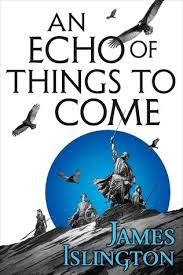
An Echo of Things To Come by James Islington (5 stars)


I'll confess I've lost a lot of context on which book was which in this series, writing the review 7 months later so I'm going to have to give them all 5 stars since that's how I felt about the overall series :)

I was so happy to see this at the start of the novel:

The following is meant only as a quick, high-level refresher of the events in The Shadow of What Was Lost, rather than a thorough synopsis.

YES! RECAP! This series is crazy complicated, tons of characters, multiple POVs, and very complex time travel as a central conceit. I needed that recap.

Some of the large plot reveals were super obvious, e.g. who is Malshash, but there were still plenty of surprising reveals. One thing that I liked a lot is that Islington didn't shy away from tragedy, the good guys can lose, catastrophically, and have to pick up the pieces. And that tragedy isn't experienced in a battle-statistics-reporting kind of way, we live through it with first person POVs.

There's a definitely some strong commentary on religion in the novel:

There is only one reason to be passionate about a lack of faith—and that is fear,” said Caeden quietly. “Fear that you are wrong. An innate need for others to share your opinion, so that you can be less afraid.” He shook his head. “I do not feel the need to argue, to cajole, to threaten or accuse. If others wish to believe differently, that is no business of mine. I simply do not think that there are gods.

Religion is the following of rules and rituals in the hope that they will somehow garner the favor of a higher power.

5 stars.

Saturday, May 16, 2020

The Shadow of What Was Lost by James Islington (5 stars)


Really great fantasy, apparently heavily inspired by Sanderson and Jordan, neither of which I've read. I get the sense from reviews that some big WoT fans are annoyed by some similarities and also a little upset at how fast the plot moves because they wanted more detailed descriptions. 

This matches really well with my experience: I don't know or care about any "Jordan did it first" criticisms, but I very much appreciate how quickly the plot moves, in a good way! This whole series feels like taking what would have been a 12-volume fantasy epic and editing out all of the time wasting boring stuff, the books that only cover the boring characters and don't advance the plot, and just nailing it.

It was actually very surprising to read fast-paced fantasy that still operates in a deep well-built world with good characters with a well-defined plot arc. Islington knows exactly where this plot is going and how he's going to tie it all together, he has to because the time travel and its implications are crazy complicated and central to the whole story.

I think part of the criticism about lack of detailed descriptions or backstory confuses what I see as a masterful control of plot reveals with a lack of backstory. Having read the full series I can say the answers are there, for the most part, but he's just not going to let you have them yet. I can't recall another fantasy novel where the intrigue is kept so long for such key concepts. I've come to appreciate that one of the most important thing a novel needs to do is keep me hungry for more, to find out why, and Islington does an impressive job of that through the whole series.

The perfect example here is the term "bleeders": we have no idea why they are called that, despite it being an incredibly commonly term, and used hundreds of times in the first book. We don't find out the backstory until halfway through the second book. That's a wait of over 1000 pages.

5 stars.


Thursday, May 7, 2020

Autonomous: A Novel by Annalee Newitz (3.5 stars)

This was in the running for a Hugo but didn't win. Big Pharma is the bad guy in this dystopian sci-fi. The things that are different is that it is a coming-of-age for an AI military robot that begins to confront gender identity and a relationship with a human. I particularly liked the idea of AIs and robots enjoying memory crashes like drugs, and selling them to each other:

The bot’s whole body spasmed, his reflexes made useless by bogus and contradictory commands. A wave of ecstatic nonsense gripped him and the file ended.

There's a lot of sex, I think at the expense of character development. There's also some genuinely creepy moments like when Eliasz climbs onto Paladin's back and becomes aroused by shooting the robot's guns...Somehow Paladin spends a ton of time examining how a relationship with Eliasz could work, but no time examining her motivations for killing tons of people to find pirate Jack. 

It was an entertaining read, but one I quickly forgot about and now don't have too much to say.

3.5 stars